Today we went for an amazing tracking walk at the South Bog Conservation Area with a group from Rangeley Lakes Heritage Trust. The day started on top of a fresh 5 inches of heavy snow, with the temperatures around freezing.
Right from the parking lot we found some wee one tracks. We learned the creatures making this size track are small rodents including jumping mouse (currently hibernating), voles (meadow and woodland), a least weasel not this far north, and the one we landed on: Peromyscus (white-footed and deer mice). We observed the tail drag, direction of travel, and bounding gait. We also took in the context, and discussed aging relating weather, snow fusion, and time.
We then walked the trail to find Chaga, a fungus used by indigenous folks for thousands of years as one of our only local adaptogenic medicines. It makes a great tea, but can be harvested irresponsibly and we learned about the honorable harvest (see Robin Wall-Kimmerer work for more information). Note, there is no commercial harvesting on any RLHT protected land.
Our next stop was at an incredibly lucky find. We found the ubiquitous but rarely seen tracks of a Flying Squirrel landing, showing where the patagia (wing like structures) cut through the snow, and the hopping pattern (vs bound).

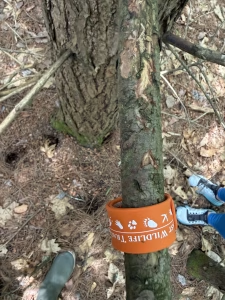
From there we took a look at some tree marks that we deduced to a deer rub (vs deer, vole, porcupine, snowshoe hare, or moose feeding sign) We even found a head hair of the deer stuck in the rub.
We also happened by a beautiful birch tree with a huge healed over scar running vertically from the base. We discussed why this was most likely a lightning strike and not the other likely cause of a freeze/thaw burst because it came from the ground and ran spiraling or curving up the tree. A lot of times you’ll also see burn scarring.
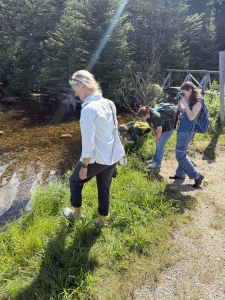
Next we were on the lookout and came to the end of the trail. But right where it meets the river we found the most exciting track of the day. We found a trail that showed an animal that jumped across the river from the bank to a boulder in the middle and then over to our side. This trail was a great discussion about the differences between our wild canines and wild felids. It started out tricky because it had the behavior of a cat but the baseline gate of a dog (trotting) we soon found out that after it’s jump it trotted in what was most likely an older coyote track for efficiency.

Under a fir we found super clear tracks allowing us to look at morphology. This morphology showed the asymmetry, larger heel pad to toe ratio, and lack of fur of the Bobcat. With this exciting discovery we followed until the animal slowed down to a walk and then exhibited hunting behavior when the forest shifted to low evergreens and we saw increased activity of snowshoe hare and red squirrel.

And one of the last scenes was when the bobcat fell through a thin layer of ice in the bog and reversed direction to loop around the unstable ground.

Thank you everyone for such a wonderful day and thanks to Rangeley Lakes Heritage Trust for hosting!