This weekend we joined up with the Appalachian Mountain Club at their wonderful Highland Center for some staff training, public talks and nature/tracking walks.

- Basic Tracking Presentation- We kicked off the weekend with an overview of Wildlife Tracking. Some key aspects included:
- Why Wildlife Tracking
- A New Way Of Seeing
- How/Why Animals move across the landscape
- Learning Tracks by Family
- Canid
- Felid
- Mustelid
- Rodentia
- Cervids
- Lagamorphs
- Ursidae
- Reptiles
- Amphibians
- Others
- Track and Foot Morphology
- Context
- Food Behavior
- Mating/Social
- Territory/Habitat
- Then we dove into the families and species including birds
- After the presentation we went for an afternoon walk. The walk included searching out what we were looking for when we have conditions (like a very heavy rain that morning in rocky substrate at elevation).
- We found lots of insect activity like leaf-curling, boring beetles, and more.
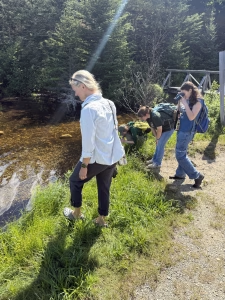
- We did some birding by the pond and it’s trail
- We identified key plant species and discussed their role in wildlife tracking
- We learned about round-lobed sundew, a local carnivorous plant from Rachel, our host

- That evening we had a similar presentation and a hands on exploration and open dialogue about
- Track Casts of several local species
- Bird Nests and architecture
- Animal Skulls and Bones including White-Tailed Deer jaw aging
- Galls and Insect Sign
- Foot Morphology of preserved species

- The next morning we went on a public nature/tracking walk.
- The first topic was how to move as trackers, slow enough to hear the birds\
- That led us to a great discussion on bird language including:
- The 5 types of calls- song, companion, young/caregiving, territorial, and alarm. We then talked about body language and broke down different types of alarms and what they might indicate including:
- Hook Ups
- Hook Downs
- Popcorn
- Linear
- Parabolic
- The 5 types of calls- song, companion, young/caregiving, territorial, and alarm. We then talked about body language and broke down different types of alarms and what they might indicate including:
- We then checked out different ages of feeding browse sign
- We learned about mosses from our host and coordinator Rachel
- We learned about different birds from naturalist Mary
- We then found a black bear trail with a bedding site!
- After that we walked the Saco Pond Trail and found pileated holes made into downy woodpecker or chickadee nest homes, caddis fly creations, hundreds if not thousands of baby toads, red squirrel middens, dragonfly wings from a most likely bird predation, and inspected an old beaver lodge.
- White-Tailed Deer- We found lots of deer tracks in the leaf litter. We explored the basics of trailing to see how we could read the leaf litter for recent deer activity and trails. We also found some ancestral trails that have been used for years.
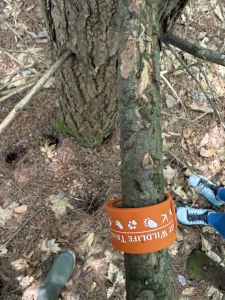
- Black Bear – We found some compelling evidence of Black Bear Club claw marks on a Red Pine, one of their favorite trees.
- Other interesting finds – We also found some Oak Galls, the similar Goldenrod Gall, and Blueberry Gall.
A welcomed send off was 2 minutes into our drive home we got to watch a Black Bear foraging in a field along the road. Thank you AMC!

Make sure to check out our other events, including our Winter Tracking Immersion at the AMC Huts in the 100 Mile Wilderness next February. We also will be posting some canoe-tracking days and other events soon!