Thanks so much for joining us at the Speare Farm Estuary Preserve! Our small group had an in-depth exploration at Knight’s Pond. A special thanks to Royal River Conservation Trust for all the work they do to steward this incredible land. The land we explored is on unceded Wabanaki territory, and we have so much gratitude to be remembering what our human animal bodies are designed for in these forests, ponds, and rivers.

Donations
Donations are split between Chebeague & Cumberland Land Trust, Royal River Conservation Trust and the Northeast Wildlife Trackers Access Fund. From this paypal link you can donate by ach, credit card, paypal or venmo:
https://www.paypal.com/ncp/payment/JLU6RLK8EK5LW
Conditions were typical of a cool and windy October day in the Northeast, crisp and a warm sun. If you want to learn more about anything we encountered, here’s a species list of tracks and sign that we saw:

Feeding Sign- This time of year everyone is eating as much as they can. It’s easy to find signs of calorie consumption before winter. Below here we have a typical white-tailed deer feeding sign. Notice the shredded side created by an animal that has only incisors on the bottom and a hard palate on the top of their mouth. Namely in the Northeast, we will see this sign with Moose and Deer. You’ll see cleaner 45 degree angle cuts from all the rodents and lagamorphs. For deer look for browsing along edges of fields or trails. Usually between our knee and chest height. For Moose, look for waist high and up, with larger diameter. Learn their favorite foods too!

More Feeding Sign- we found more typical by species feeding sign too:
- On the left White-Tailed Deer on Acorn, looking mashed, with molar indents, found along an active deer trail.
- The picture on the right is a midden and abandoned pine cone left by a red squirrel. Zephyr spoke about the clean ‘cob’ left indicates the red squirrel (likely not grey in this area or conditions) vs. a chipmunk that will leave a frayed look to the ‘cob’.


In addition to lots squirrel feeding Becca found this mushroom with two different feeding signs on it. On top you see the trail of a snail feeding. Along the edge you see a small rodent feeding with incisor marks.

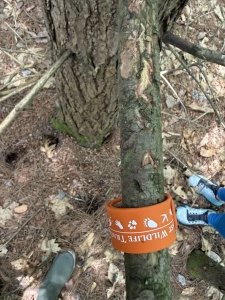
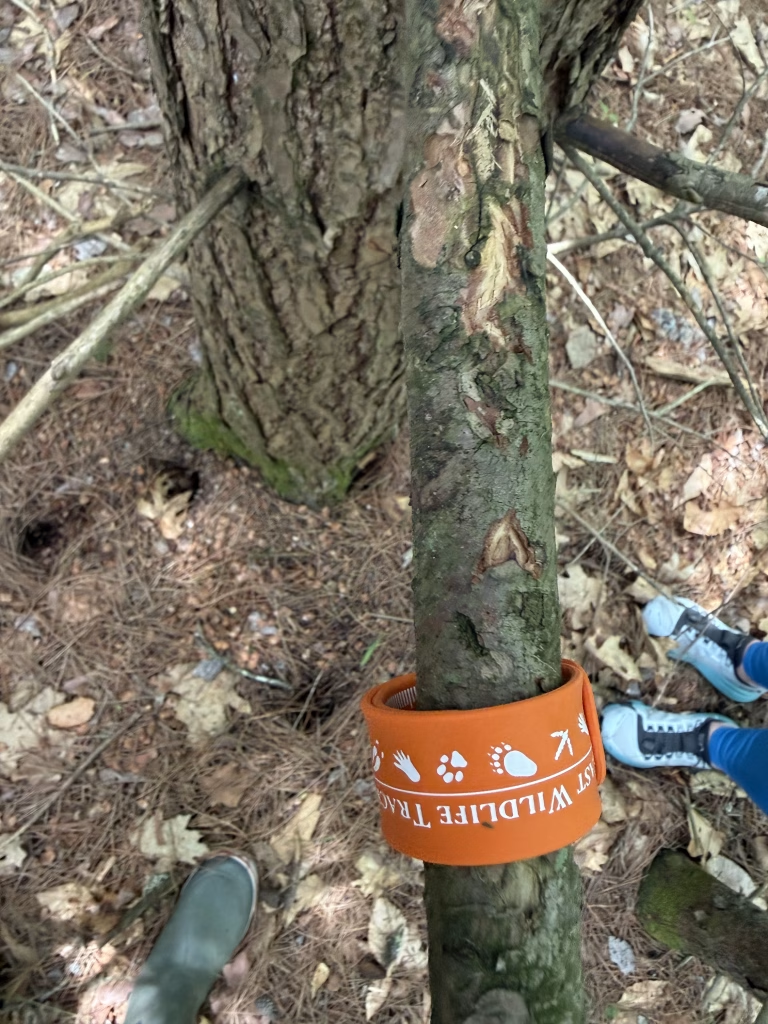
Sap Tapping- One of our favorite finds below! This is an old and healed over version in the middle of this picture (look for a dot dash dot pattern), but very common on maple saplings, usually smaller than this. When the sap runs (below freezing at night, and above freezing during the day) you’ll find Red Squirrels (Grey and Flying possible) tapping Maple trees. They take one bite out of the tree and leave it to run and evaporate to condense the sugars. Then, they come back and lick up the sugar rich sap for some much needed calories while they build their homes for the ever decreasing temperatures.

Eastern Chipmunk tunnel vs cache- This was a great opportunity to look at a clean and tidy entrance to a tunnel on top, and a messy digout of a cache from an Eastern Chipmunk. We discussed differences from the Red Squirrel holes. Chipmunks are less arboreal, meaning they don’t escape to trees as readily as Gray and Red Squirrels do. They like no obstructions and holes are usually out in the open of a lawn or trail so that they can easily escape an aerial predator. They also are hunted by terrestrial predators that can dig so they keep a clean hole, with little mess and scent to give away their activity. Another key indicator is a Red Squirrel hole typically goes into the substrate at an angle while the Chipmunk digs straight down for the length of your hand and then turns.

This was another clear example on the trail of an Eastern Chipmunk entrance.

Other interesting sightings included a Red-Bellied Woodpecker and lots of Blue Jays. Hope to see you at our next Wildlife Tracking Club in Casco Bay area or the Mahoosuc area. Make sure to check out our other events, including our Winter Tracking Immersion at the AMC Huts in the 100 Mile Wilderness next February.